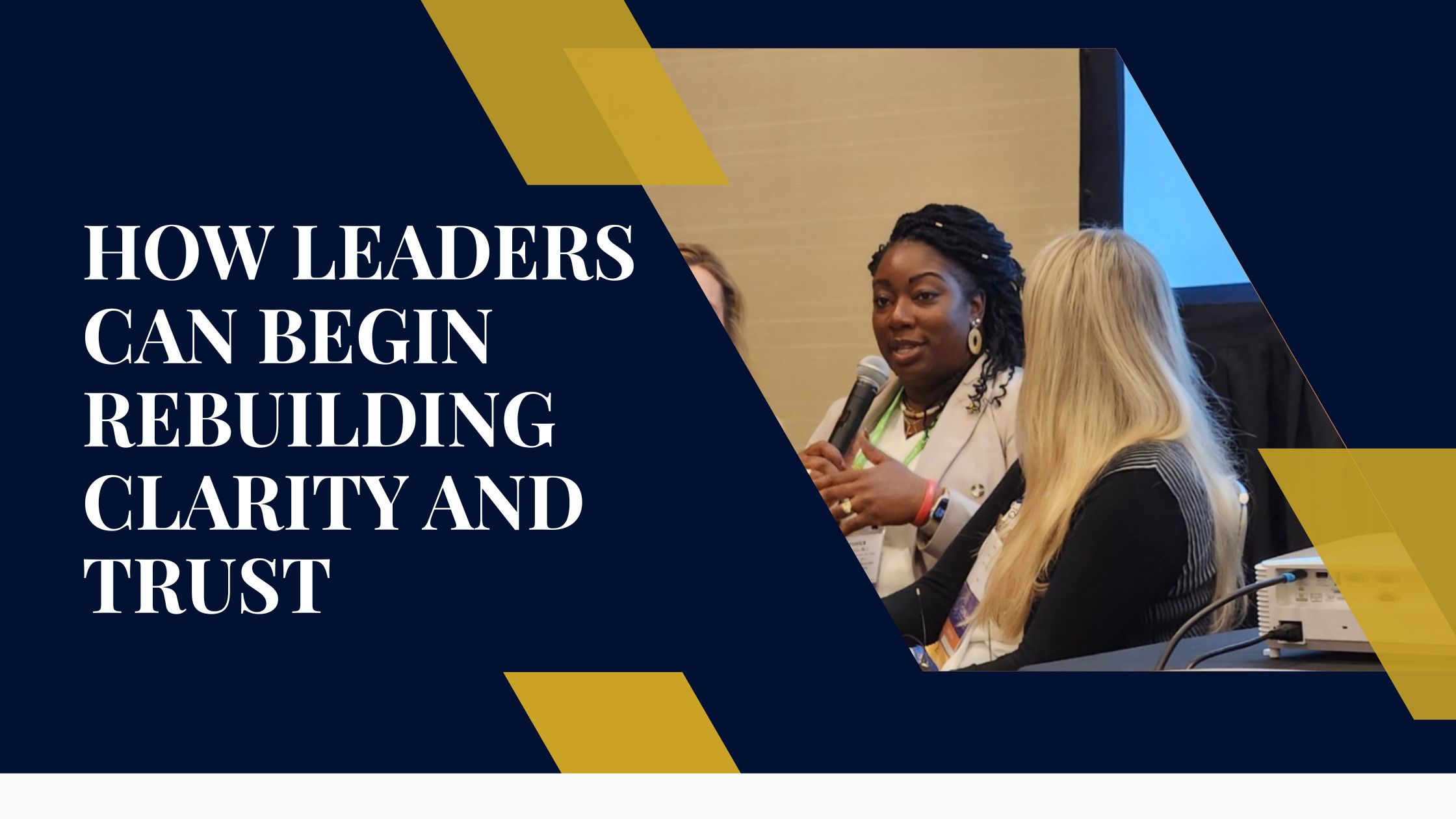
How Leaders Can Begin Rebuilding Clarity and Trust
In my work as a senior human resources leader and higher education administrator, one truth consistently emerges:
Clarity and trust are often the first casualties of sustained pressure, yet the most critical elements to restore when organizations experience fatigue, disruption, or change.
Clarity involves establishing a shared understanding of vision, values, goals, roles, and expectations. It reduces uncertainty and ambiguity, helping leaders and teams make decisions with confidence. Trust, by contrast, reflects belief in the reliability, integrity, and intentions of others. It is closely tied to psychological safety, which is the assurance that individuals can speak up, take risks, and learn without fear. These two concepts are deeply interconnected.
Clarity builds confidence, but trust enables clarity to take hold. Clear plans reduce anxiety and confusion; however, without trust, even the most well-defined strategies falter. People are unlikely to act, innovate, or raise concerns unless they feel safe and supported.
Today’s leaders are navigating complex and rapidly evolving environments characterized by competing priorities, difficult decisions, and heightened expectations, often while managing their own limited capacity. Over time, this sustained strain can cloud judgment, weaken communication, and create distance between leaders and their teams. When clarity erodes, trust soon follows.
Rebuilding clarity begins with intention. Leaders must pause to reconnect with their purpose, both personal and organizational.
This reflection requires honest examination: What motivates my leadership? Am I leading authentically? Do my actions align with my values? How do I support growth in myself and others?
Clarity does not require having all the answers. It requires transparency about direction, priorities, and expectations. Teams do not need perfection; they need consistency, honesty, and leadership they can depend on.
Trust is restored through presence, acknowledgement, and follow-through. Leaders often underestimate how much trust can be rebuilt by listening attentively, naming uncertainty, and communicating with care. Trust grows when leaders model ways to know their own emotions and understand others’ feelings. Trust grows even further when leaders hold themselves accountable, communicate well, and invite dialogue rather than defensiveness.
Ultimately, clarity and trust are sustained when leaders move from survival-driven leadership to intentional leadership. This shift requires boundaries, values-based decision-making, and an awareness that how leaders show up sets the tone for the entire organization.
The Call to Lead Differently: Rebuilding clarity and trust begins with intentional leadership choices made daily, not grand gestures. The work starts with how leaders reflect, communicate, and show up. I encourage you to explore these commitments which offer a practical reset for how leaders show up for themselves and their teams:
Examine your leadership motives with sincerity. Be honest about your “why” and ensure your actions align with your values.
Lead with clarity, not constant urgency. Step back, pause, and make it plain. Clear priorities and expectations reduce confusion and restore confidence.
Communicate with intention, not assumption. Say what needs to be said, clearly and respectfully, and invite understanding.
Build trust through presence, empathy, and consistency. Show up reliably and lead in ways that make people feel seen, heard, and supported.
Leadership today is not about carrying the weight alone. It is about creating environments where people feel grounded, valued, and empowered to do their best work. When leaders rebuild clarity and trust, they do more than stabilize teams, they create the conditions for resilience, sustained performance, and meaningful progress.


